How distributed cognition launched on X
Our mission is to replicate humanity's collective intelligence
What distributed cognition launched

Today distributed cognition exits out of stealth with backing by Verdict Capital. Our mission is to replicate humanity's collective intelligence. Read more: https://t.co/HAdwrIdj5B Most of today's AI power is held in the hands of a few, who can choose what you're allowed to https://t.co/vR3H3h6hi3
How LaunchVideo.com rated the launch
LaunchVideo.com rating
About the launch
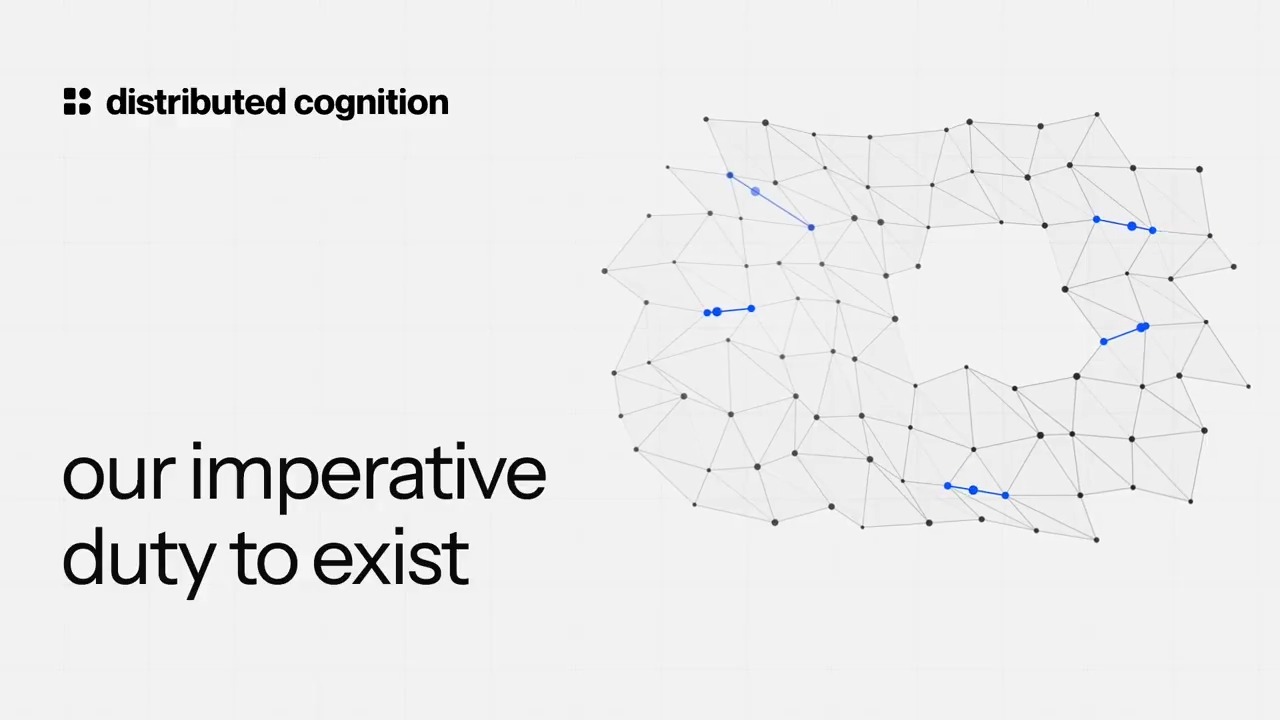
What did distributed cognition launch? Distributed cognition left stealth on October 22, 2026, with backing from Verdict Capital. The company's launch post stated its mission in one line: to replicate humanity's collective intelligence. It is training the communication layers and inter-model adapters that let specialized models coordinate, from labs in Palo Alto and Zürich. The work is aimed at researchers and operators who want that coordination outside a few closed frontier systems, on the view that further gains will depend on how models are connected as single-model scaling runs into limits on training data. What is topological superintelligence? The company calls its longer program topological superintelligence (TSI): choose the topology and the communication method for the task, then combine architectures that are each expert in a narrow field. Its site borrows the mathematical idea of superadditivity, where combining two or more elements produces something greater than the sum of their individual contributions. In that view, superintelligence will not be a single all-powerful model but a collective of specialized intelligences reaching capabilities none could reach alone. Early applications they name are game theory, economics, and behavioral modeling, and they plan to release the research in public. What research came with the distributed cognition launch? In a paper posted the week of the launch, Steven Motta and colleagues show a jury of nine open models, each at most 3 billion parameters, estimating which expert to trust from unlabeled answers alone. On a benchmark of 1,560 questions, that jury beat the strongest single model in the pool by 2 points. A few weeks after the launch, the company introduced VINCO, a specialist model for competitive one versus one CATAN. Distributed cognition says its two accounts held first and second place on Colonist's global 1v1 CATAN leaderboard on November 1, 2026, with under 24 hours of total gameplay, before the team stopped early. The model has roughly half a million parameters, was trained without any human games using offline reinforcement learning and self-play, and reached the top ranks in less than a day of training on two GPUs. The company presents it as evidence that a compact specialist can beat general language models at planning under uncertainty. What does the distributed cognition memo argue? The public surface of the launch is a memo titled "our imperative duty to exist," signed by Motta and described as fully human written. It argues that the current landscape is split between frontier labs that keep large models closed and labs that release smaller open models, and that neither approach is enough. The memo argues that post-training can bend a model toward the preferences of the lab that trained it, and that released models should stay closer to the data they were trained on. It also draws on the cognitive tradeoff hypothesis from anthropologist Tetsuro Matsuzawa to argue that human intelligence comes from communication between many minds rather than from any single brain, which is the idea the company wants to reproduce with models. Alongside the memo, the launch opened a waitlist for Vivarium, their family of topological models, with open source access promised to people on the list, and published Manifold, a weekly matrix of how frontier architectures differ by capability. Manifold compares families such as large language models, world models, spiking neural networks, and liquid networks, with each rating linked to an experiment or marked as anecdotal or theoretical. Who is behind distributed cognition? Steven Motta signed the launch memo and is the lead author on the model jury paper. Michal Valko, previously involved with Llama at Meta and with Gemini at Google DeepMind, has joined as an advisor. The company is incorporated as Distributed Cognition, Inc. and lists research on its site, with code and models shared through GitHub and Hugging Face. How did the distributed cognition launch perform on X? The distributed cognition launch video went out from the company account on October 22, 2026. The post reached 1.2M views, with 577 likes, 110 reposts, 191 comments, and 338 bookmarks, as recorded on this LaunchVideo.com directory entry. The account had about 700 followers at the time, which means the post reached well over a thousand times its own audience. The video itself is a 14 second clip, and most of the message sits in the post copy and the linked memo. LaunchVideo.com rated the launch 3.6 out of 5, with 5 out of 5 for both sentiment and distribution, 4 for copy, and 2 each for hook and editing. What can founders learn from the distributed cognition launch video? The distributed cognition launch video shows that a research company can win attention with an argument rather than a demo. The post leads with a mission and a provocation about who controls AI, then sends readers to a long memo. For a lab with no product to show yet, a clear point of view is the asset. It also shows that distribution can matter more than production. A short clip from a brand new account reached seven figures because the idea was shareable and the post traveled through the right networks on launch day. For founders, the gap is the visual hook. A few seconds that show the research working, such as the model jury in action, would make the launch easier to understand at a glance. Founders weighing how much to invest in film versus distribution on X can compare launches like this one across the LaunchVideo.com directory.
Tags
Questions
Frequently asked questions
The distributed cognition launch post reached 1.2M views on X, with 577 likes, 110 reposts, 191 comments, 338 bookmarks.
distributed cognition launched on X on October 22, 2026 with the message "Our mission is to replicate humanity's collective intelligence".
What did distributed cognition launch?
LaunchVideo.com rated the distributed cognition launch 3.60 out of 5: hook 2/5, editing / creativity 2/5, copy 4/5, sentiment of launch 5/5, distribution strategy 5/5.