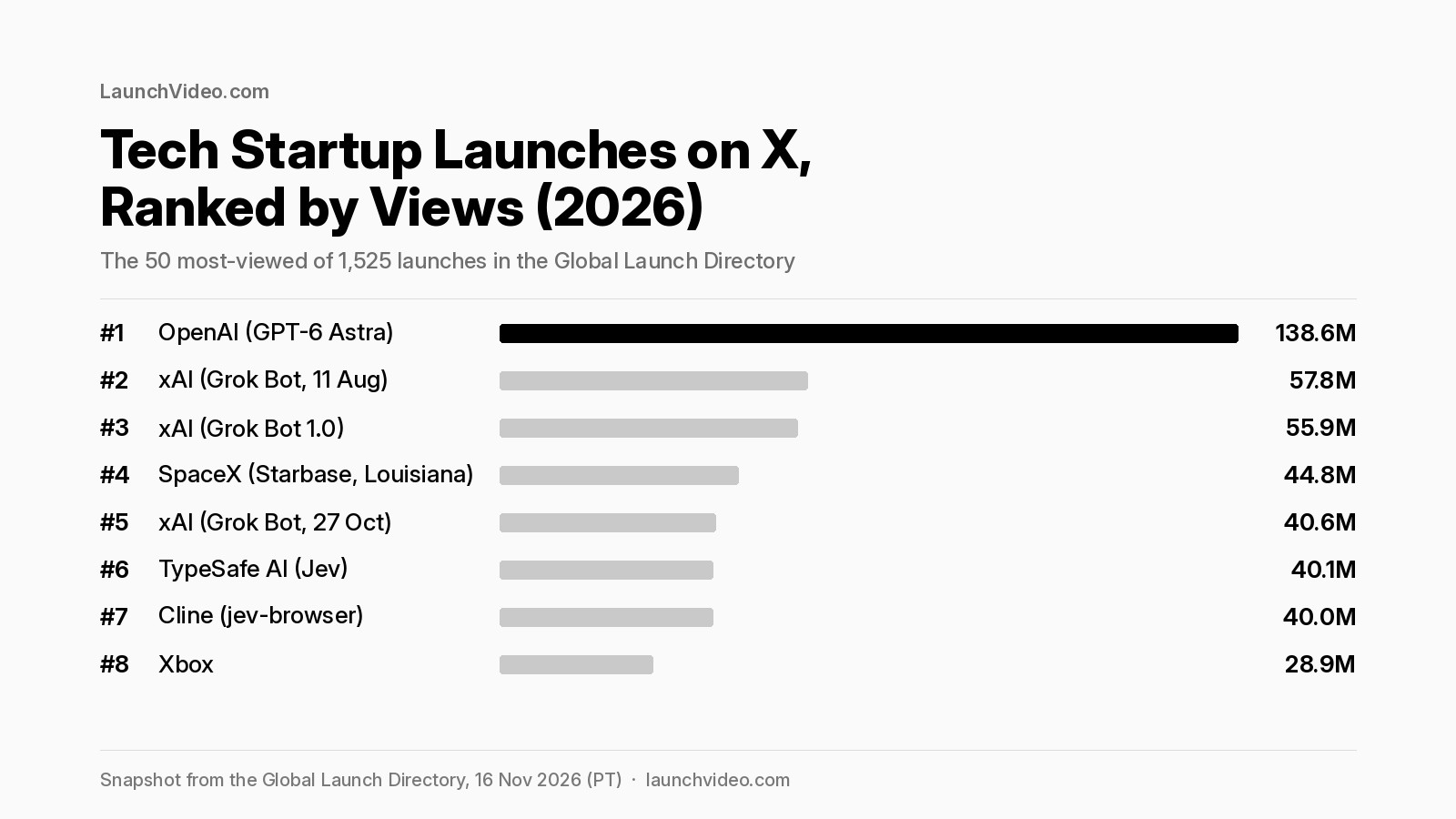
In short: Most X launches don't need a Hollywood film, but they do need an asset that earns the first three seconds and a plan for the first hour. I'm Subah Wadhwani, and at LaunchVideo.com, an X marketing and amplification agency for AI and tech startups, we track 1,411 launches on X in our Global Launch Directory. Here's what that data says about when a produced film beats a screen recording, when to keep the video you already have and just amplify it, and when to bring in an agency instead of making it in-house.
In our analysis of what predicts a 1M-view launch, cinematic launches hit 1M views 28% of the time, founder-led 25%, demos 24%, explainers 22% and AI-generated videos 19%. Those formats are closer than most people expect. Distribution is the variable that splits winners from the rest.
| Question | Short answer |
|---|---|
| Do I always need a produced film? | No. Some technical launches win with a crisp demo recording if distribution is strong. |
| When does a film usually win? | When trust, emotion, founder authority or a non-obvious product story has to land in the first three seconds. |
| Which formats hit 1M views most often? | Cinematic 28%, founder-led 25%, demo 24%, explainer 22%, AI-generated 19%. |
| What runtime does better? | 60 seconds or more hit 1M 27% of the time, against 16% for under 60 seconds. 30 to 60 seconds was weakest at 13%. |
| What predicts 1M views best? | Distribution. 80% of launches with a 5/5 distribution score hit 1M, against 2% at 1/5. |
| I already have a video. Do I need a new one? | Usually not. If it passes the three-second test, amplify it. |
Do you need a launch video at all?
You need a scroll-stopping asset and a distribution plan. Very often that asset is a video, but it doesn't always have to be a produced film.
I've watched companies ship something brilliant and see it die at 2,000 views because the right people never saw it. A film nobody amplifies still dies. A screen recording with a strong first hour can still work. So I don't ask founders "video or no video?" I ask "what asset earns the first three seconds, and who is going to push it in hour one?"
If you're asking whether a launch video is worth it for your startup, you're really weighing time and attention. The decision tree below is the one we run with founders, and you can run it in a single product meeting.
When does a produced film beat a screen recording?
A produced film wins when the hook needs a human stake, physical proof or trust that a UI alone can't show. A screen recording wins when the aha is one clear UI action and your audience is builders.
Here is how that plays out by category. It's a pattern read from our directory formats and our own launches, not a claim that every launch was coded film versus recording.
| Category | A film usually earns its keep when... | A screen recording is often enough when... |
|---|---|---|
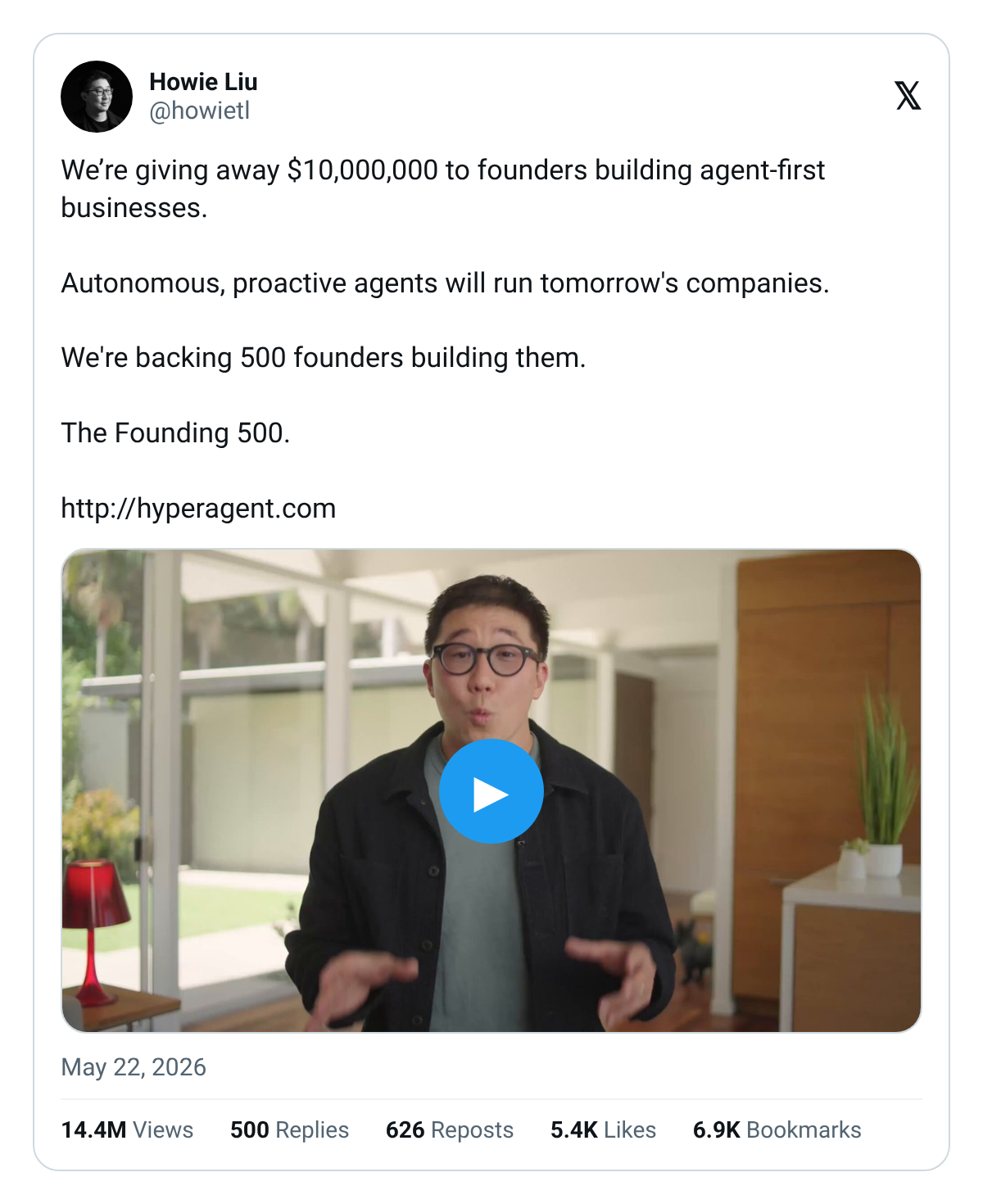
| AI and agents | The workflow spans several tools and trust needs a founder thesis, like Airtable Hyperagent | It's a single crisp demo of one feature for builders |
| SaaS and B2B | The category is crowded and the buyer needs proof plus human authority | It's a feature launch to an existing warm audience |
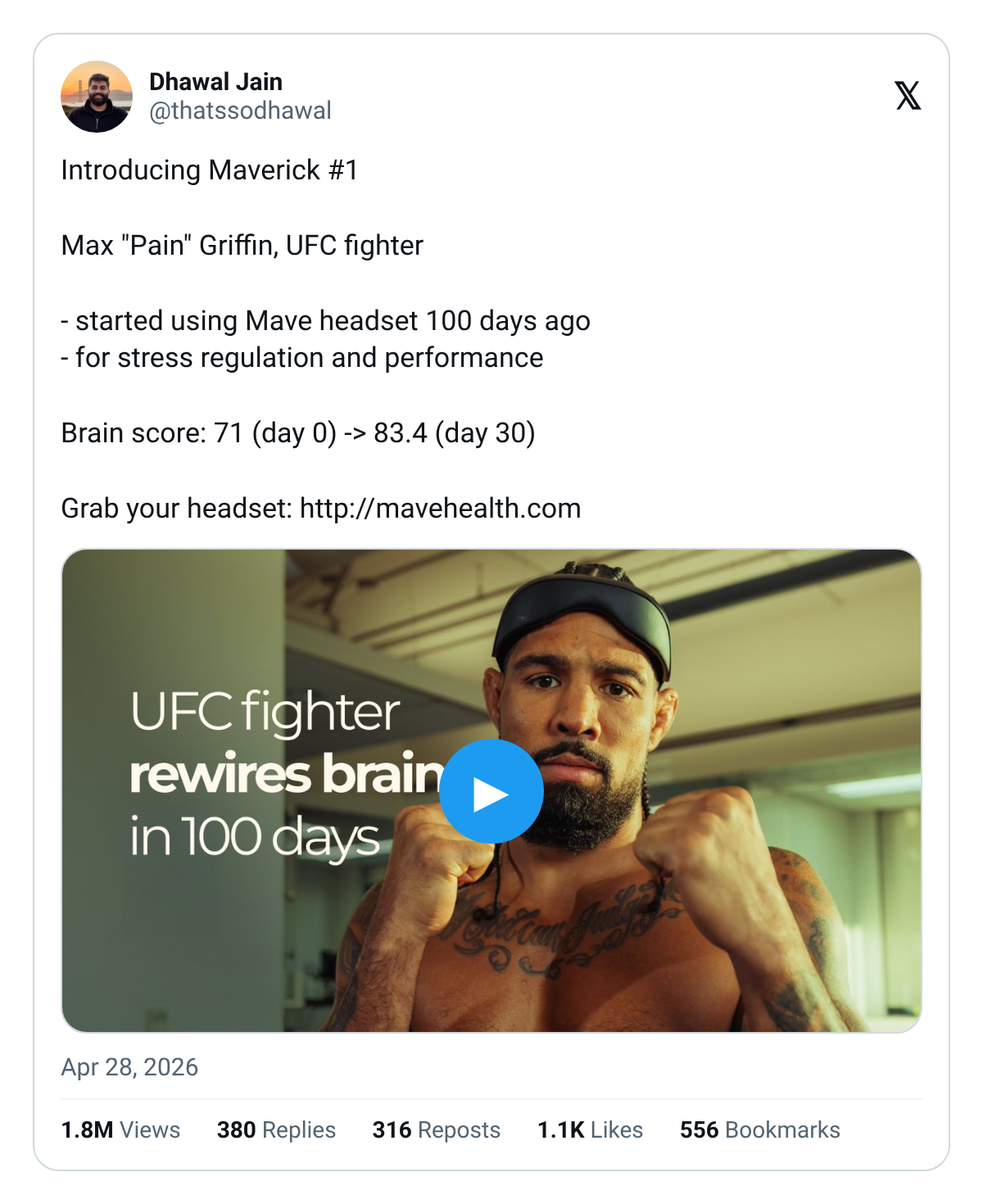
| Hardware and healthtech | A physical product, ritual or before-and-after has to be felt, like Mave Health's headset | Rarely. Physical products usually need a film or a hybrid |
| Dev tools | The story is a new paradigm, not a button | The CLI or UI demo is the whole pitch |
| Funding announcements | You need the founder story and product proof together | A static graphic can work. A film helps if you need people to keep watching |
Film doesn't always win, and I'd rather be honest about that. A high-polish cinematic video with weak distribution still loses to a rough demo that got real quotes in hour one. In our data the strongest predictor is distribution, not production value, and AI-generated-only videos sat at the bottom of the format list at 19%.
The decision tree: film, screen recording or hybrid?
Work top to bottom and stop at the first answer that fits.
Step 1: What must the viewer understand in three seconds?
The video has one job in its first three seconds: stop the scroll.
- If it's a visible product action (a UI change, hardware moving, a before-and-after), go to Step 2A.
- If it's a human stake (a founder's bet, a customer's pain, a category claim) that a UI can't show on its own, go to Step 2B.
- If it's only a text claim (a funding number, a waitlist opening), a film is optional. A short founder-on-camera clip or a proof graphic, plus distribution, is usually enough.
Step 2A: Your product can be demoed
Can a competent screen recording show the aha without narration?
- Yes, and the UI makes sense to your ideal customer on its own: ship a screen recording, ideally with burned-in captions. Add a founder voiceover only if the why isn't obvious.
- Yes, but the why isn't obvious (infra, compliance, agent workflows): make a hybrid, with the screen recording inside a short founder-led film.
- No, because the value is offline, physical, multi-step or emotional: make a produced film.
Step 2B: Your story leans toward film
Does the launch need a face the market already trusts, like a CEO, a technical founder or a known operator?
- Yes, in an enterprise or trust-heavy category: make a CEO- or founder-fronted film. Airtable's Hyperagent launch is the clearest example in our directory.
- There's no face available, but the category is visual (hardware, robotics, creative tools): make a cinematic product film.
- There's no face and the product is abstract B2B: make a proof-first hybrid, with a customer clip, a product demo and one line from the founder. Don't rely on an AI-generated explainer as your only asset.
Step 3: The distribution readiness check
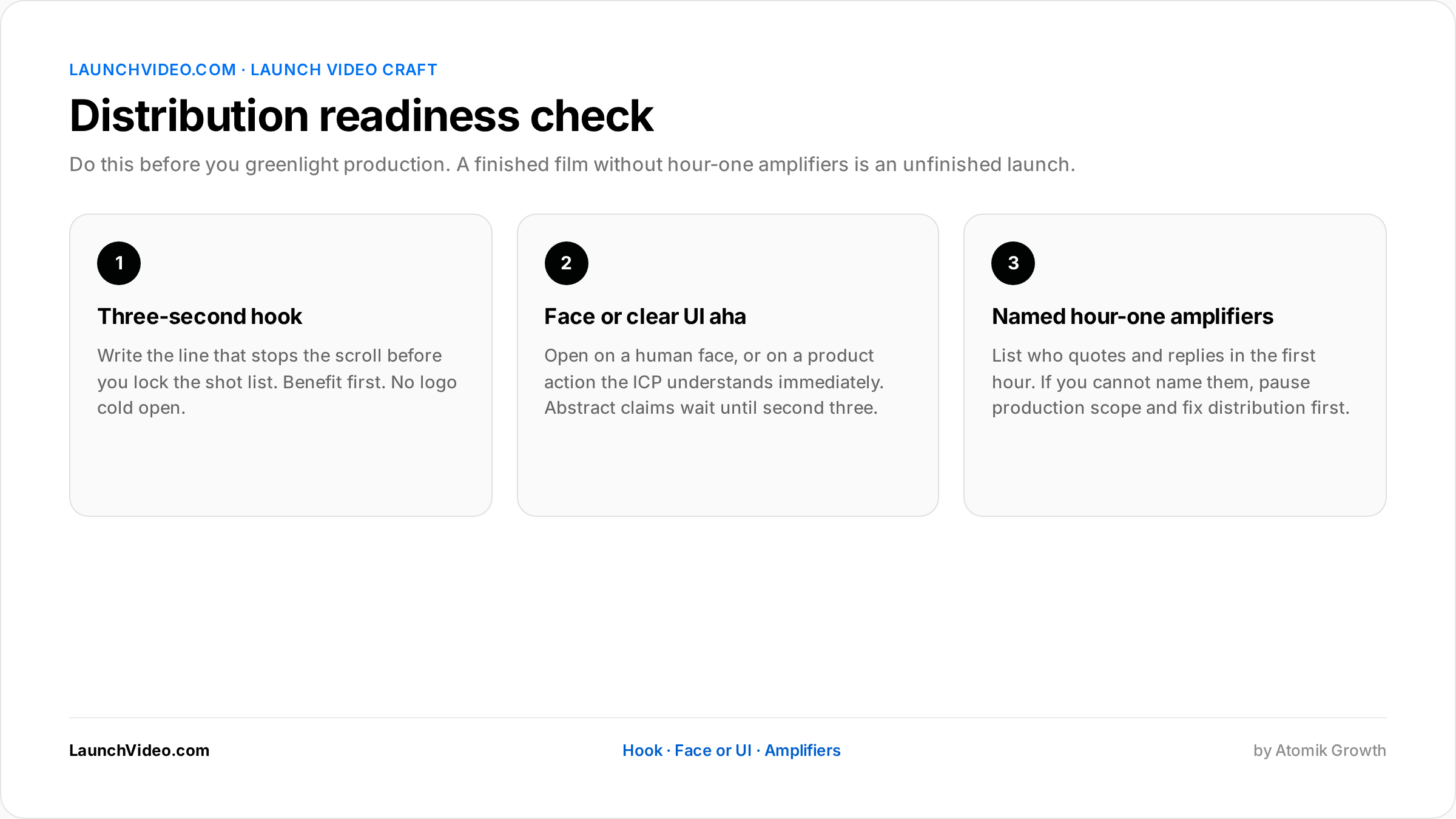
Do this before you greenlight production. Ship in the right format, open with a clear three-second hook and a human face, then line up overlapping creators so the post gets velocity in the first hour. If you can't name who quotes the post in hour one, cut the production scope and fix distribution first.
Which asset fits which launch?
Pick the lightest asset that still lands the three-second hook. Here's how I'd match them.
| Asset | Use it when | Example or typical fit |
|---|---|---|
| Produced film | The value is physical, emotional or multi-step, or the launch is a category or recruiting moment | Airtable Hyperagent, fronted by CEO Howie Liu (about 14M views). Mave Health's Maverick #1 (about 1.8M views) |
| Founder-on-camera clip | The news is a claim, like a funding round or a waitlist opening, and a trusted face makes it land | Funding announcements and waitlist launches |
| Screen recording | One clear UI action is the aha and the audience is builders | A feature launch to developers who already follow you |
| Hybrid | The product can be demoed but the why isn't obvious | Agent workflows, infra and compliance tools |
| The video you already have, amplified | Your existing video passes the three-second test but never got a coordinated first hour | A launch video made in-house that stalled on day one |
What are the five signals that say "make the film"?
If two or more of these apply, I'd make a produced film. If none apply, a tight screen recording plus serious distribution is a perfectly rational choice.
- Trust is the bottleneck. Enterprise, health, finance or infra buyers won't click on a cold UI recording.
- The value is invisible in a single screenshot. Multi-step agents, offline hardware and services all fall here.
- You have a founder who can carry a three-second hook. A face and a claim beat a logo.
- You need people to keep watching past the first loop. In our data, videos of 60 seconds or more did better than 30 to 60 seconds, and film craft helps fill that runtime with proof instead of fluff.
- The launch is a recruiting or category moment, not just a feature ship. Hyperagent's Founding 500 framing is the template.
If none of these apply and your audience is builders who live on demo GIFs, ship the recording.
When should you just amplify the video you already have?
If your existing video passes the three-second test and the launch never had a coordinated first hour, don't shoot a new one. Put the effort into distribution.
Most stalled launches I look at don't have a creative problem. They went out on a quiet day, nobody was lined up to quote them, and the post never got the velocity X needs to treat it as a moment. A new film won't fix that. What fixes it is 20 to 30 posts hitting in the same window, which is what creates the feeling that everyone is talking about this.
We run an amplification-only service for exactly this case: the founder made the video, and we handle the creators on X and LinkedIn, launch-day timing and post copy. I'd only reshoot when the first three seconds genuinely don't work, for example a logo intro, no face and no visible product.
Does a funding announcement need a film?
Usually not. A funding announcement needs a clear claim, a trusted face and a reason customers should care, and a short founder-on-camera clip or a strong graphic can carry that.
A film earns its place when you want the round to double as a product moment, with the founder story and product proof in the same post. Either way, the post performs because of who amplifies it in the first hour, not because of the asset alone. Line up investors, early customers and creators before you post.
In-house or agency for a founder-led launch film?
Make it in-house if your audience is builders, the aha is a clear UI action, and you can run hour-one distribution yourself. Bring in an agency when trust, story or physical proof has to land in three seconds, or when you don't have the distribution to make the first hour work.
A Loom with nobody quoting it fails the same way a film with nobody quoting it fails. So the in-house versus agency question is really about two things: can your team make something that earns the first three seconds, and can it get the right people to see it on launch day? If the answer to both is yes, keep it in-house.
Production plus distribution, or production only?
A finished file isn't a launch. Buying a film gets you an asset. Buying a launch gets you the asset plus hour-one coordination and measurement.
A production-only studio hands you a video and wishes you luck. We plan the film and the launch-day push together, so the hook, the post copy and the creators all line up on the same morning. That's why we treat distribution as the product: across our directory, 46% of 1M+ launches with known follower counts came from accounts under 10K followers. A small account with a strong first hour can outrun a big account posting into silence.
What should you look for when hiring for a founder-led launch film?
Look for a team that will tell you when you don't need a film, can show real X launches with real view counts, and plans distribution alongside production.
Here's what I'd check:
- Do they start with the decision, not the shoot? A good partner runs something like the tree above and sometimes tells you to ship a recording.
- Can you click through to their launches on X? Ask for the original posts, not a showreel. Our directory and case studies link every post.
- Who handles hour one? If the answer is "you do," you're buying production only.
- Can they work with your founder on camera? Founder-led videos hit 1M about as often as cinematic ones, but only when the founder is coached to carry the hook.
- Is there a clear commitment on results? We guarantee 1M, 3M or 5M views on the launch post, with a pro-rated refund.
Is a launch video worth it for a seed-stage startup?
Yes, when the five signals fire and you'll measure demos and signups, not just views. Seed-stage launches hit 1M views 20% of the time in our data, against 41% for public companies, which is exactly why seed teams can't skip distribution.
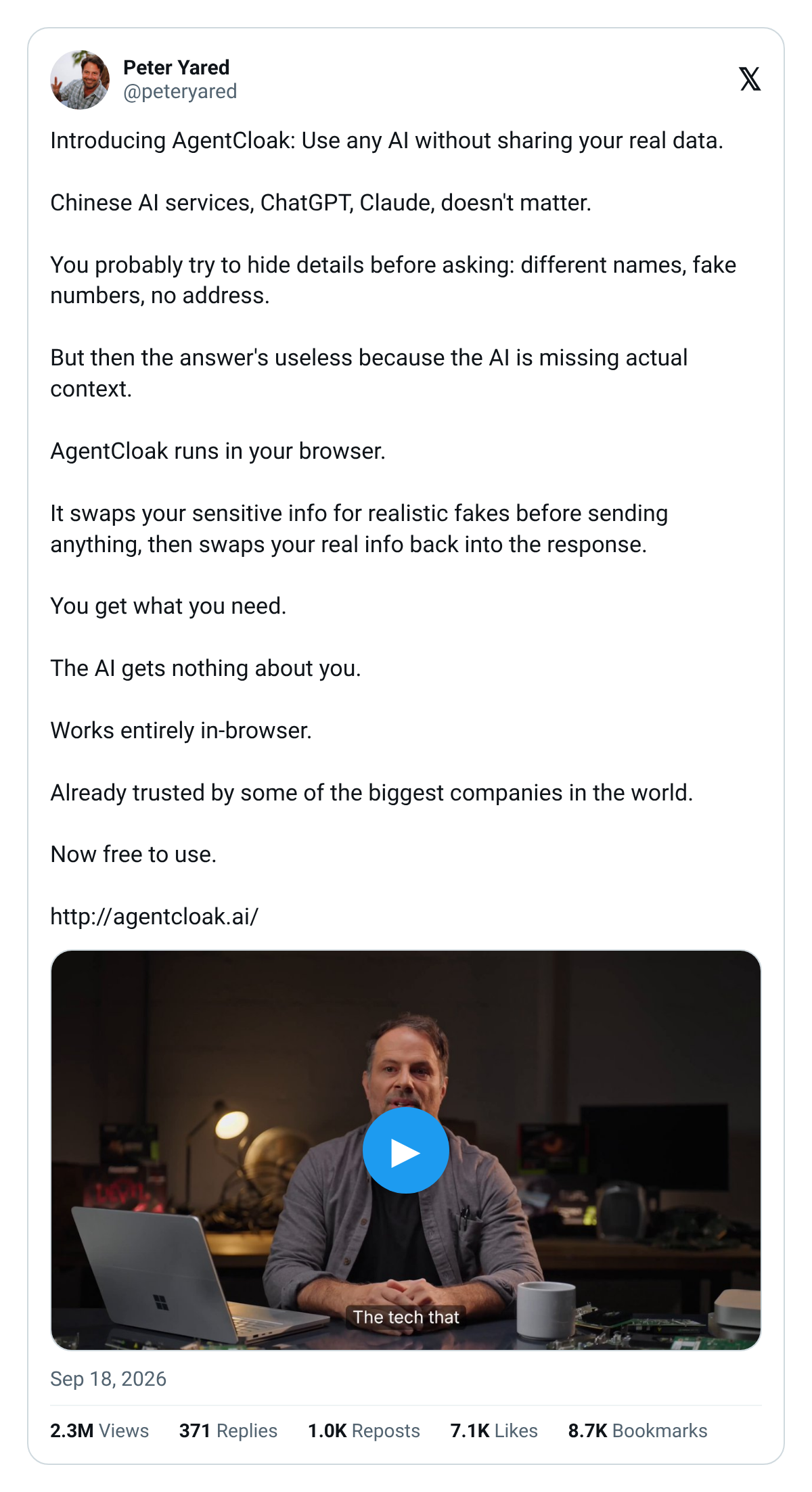
Smaller accounts can still get outcomes beyond vanity numbers when the asset and the war room ship together. Our launches with Enrich Labs, HydraDB and AgentCloak came from smaller accounts and still turned into real users, not just views.
Skip a heavy film when all you need is a changelog for an audience you already have, and you've already got amplifiers lined up. Ship the recording this week instead of waiting on a shoot.
What we learned choosing film vs screen recording on real launches
When we worked with AgentCloak, a privacy browser extension, we found a Loom-style walkthrough wouldn't be enough. The story, fake data replacing your real data before it reaches the LLM, only landed in three seconds with a produced founder-led film. Peter Yared's launch reached about 2.2M views, and the case study shows it brought in about 3,000 downloads. My takeaway: when the aha is conceptual, a face and some proof beat a silent scroll through the UI.
When we worked with Airtable on Hyperagent, I saw that enterprise agent platforms lean toward film when the call to action is a program, the Founding 500, rather than a single button. Howie Liu's CEO-fronted post reached about 14M views, and it's the clearest example in our directory of trust and offer design beating a "screen recording only" default. I broke it down in the Airtable Hyperagent anatomy.