How Prescience announced a documentary about its game-playing health system on X
Health insurance rebuilt for the modern employer
What Prescience launched

AI systems are already superhuman at playing games: Chess, Go, Starcraft. @GetPrescience is the first health system that models medicine as a game. It plays to win, and it’s really good at it. We invited a team to film a short documentary about what we’re building. https://t.co/lDI9OTqe9v
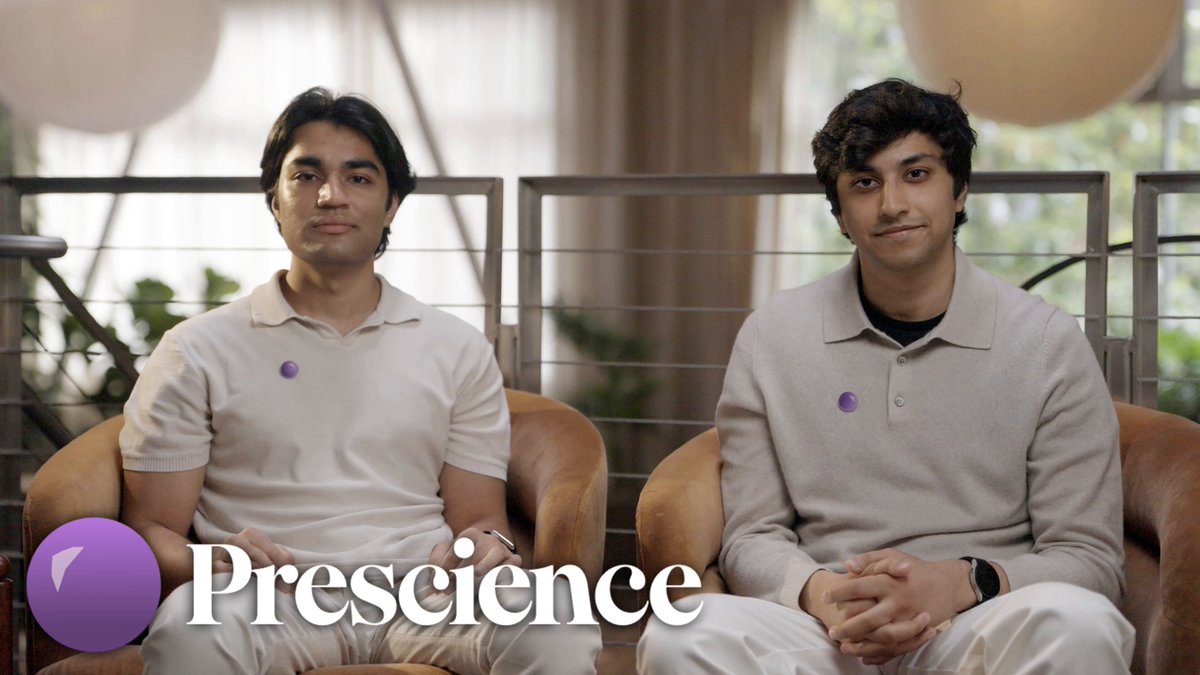
Transcript
How LaunchVideo.com rated the launch
LaunchVideo.com rating
How the launch performed
- 69K
- views on X
- #1197
- of 1784 launches we track
- 0.4x
- the 193K median launch
What this launch shows
| Group | Views |
|---|---|
| Prescience, this launch | 68,599 |
| AI Healthtech launches, median across 25 launches | 83,720 |
| Every launch, median across 1784 launches | 193,327.5 |
Prescience reached 69K views, 0.4 times the directory median of 193K, ranking 1197 of 1784 launches we track. Among AI Healthtech launches it ranks 14 of 25, 0.8 times that group's median.
Replies ran at 8.5 per 10,000 views, well above the 3.9 median. Conversation in the first hours is what the ranking model rewards with more reach. Bookmarks came in at 28.9 per 10,000 views against a median of 15.3. There was one bookmark for every 2.2 likes.
It went out on a Tuesday.
More launches in its category
 AugustAI that handles healthcare tasks like booking doctors and filing insurance claims3.7M views
 OpenEvidenceAmerica's Official Medical Knowledge Platform3.2M views
 ConcurrencePredicts each patient's health future to change outcomes early1.6M views
 UniqueHumanProactive agents for a new era of continuous healthcare1.1M views
 OpenAITo ensure that artificial general intelligence benefits all of humanity996K views
About the launch
Prescience operates an employer-sponsored health plan that acts as both the payer and the provider, letting it change what care members receive rather than just adjudicating claims. It is aimed at companies buying benefits for their teams, and the pitch is a plan built around an AI decision system rather than around the incentives of a traditional insurance carrier. The launch matters because the founders are showing the underlying model publicly for the first time, framing coverage design and clinical choices as a single optimization problem. The system has two parts described in the launch. Time Machine is a representation model that compresses a member's longitudinal health data into candidate future trajectories, and Crystal Orb is a dynamics and prediction layer that scores sequences of clinical actions against long-run health outcomes. The team illustrates the approach with a recurrent UTI case where the model preferred a narrower, older antibiotic over Cipro to preserve future efficacy, a move most urgent-care workflows would not make because they optimize for short-term symptom resolution rather than years-out risk like sepsis from resistant infection. Prescience is a Y Combinator company based in San Francisco, founded by brothers Rishab Jain and Aditya Jain, MD, who come out of Harvard and Harvard Medical School with backgrounds in machine learning and clinical medicine. For founders and operators evaluating benefits, the relevant question this launch raises is whether an integrated payer-provider running a learned policy can actually outperform the status quo on both member outcomes and employer spend.
Tags
Questions
Frequently asked questions
The Prescience launch post reached 69K views on X, with 432 likes, 40 reposts, 58 comments, 198 bookmarks.
Prescience launched on X on August 18, 2026 with the message "Health insurance rebuilt for the modern employer".
Prescience operates an employer-sponsored health plan that acts as both the payer and the provider, letting it change what care members receive rather than just adjudicating claims.
LaunchVideo.com rated the Prescience launch 4.20 out of 5: hook 4/5, editing / creativity 5/5, copy 4/5, sentiment of launch 4/5, distribution strategy 4/5.