How Vorelios launched its AI lab for engineering anything on X
Models that predict design behavior in seconds and autonomously improve designs
What Vorelios launched

Today we’re launching @vorelios (YC F26)! We’re a research lab building AI that can engineer anything. Models that predict a design’s behavior in seconds and use those predictions to invent and improve designs autonomously. 🧵 w/ @krish_k07 , @ycombinator https://t.co/7NdLIv1q0J
How TLVC rated the launch
TLVC Rating
About the launch
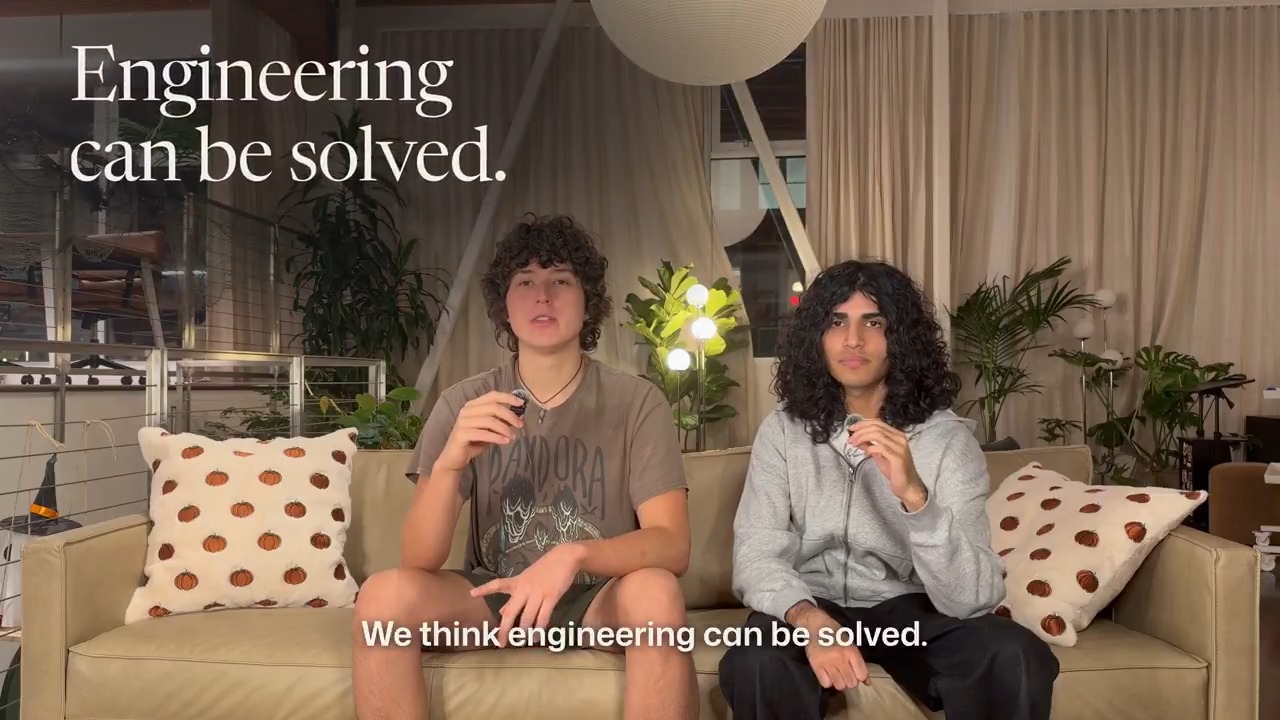
Vorelios, a YC Fall 2026 research lab in San Francisco, is launching models for engineering teams that still wait hours or days on a single simulation. The model takes a design's geometry and operating conditions and predicts fluid flow, heat transfer, and structural behavior together, in a fraction of a second, on clean CAD of full-scale designs. Those predictions feed an autonomous search. In the company's first end-to-end runs, the system took a written spec, searched thousands of candidates, and refined the best ones with no person in the loop. The launch video shows that loop on a supersonic jet given one goal, fly at Mach 1.7 while burning as little fuel as possible. The system changes the aircraft, simulates the whole design, and keeps a change only when fuel burn drops. On its results page, Vorelios reports lower pressure and skin-friction error than Transolver-3 and AB-UPT on held-out cases from the NASA Common Research Model, BlendedNet++, and HiLiftAeroML, with a full surface prediction in about 1 to 31 milliseconds on an H100. The founders say those public benchmarks mostly resemble the training data. On families of designs outside that set, earlier models failed, including their previous architecture, and they say closing the rest of that gap is the center of the research. An independent solver, they report, found the first autonomous designs beat a typical candidate, with predictions within a few percent. Daniel McNeil (CEO) and Krish Kapadia (CTO), both 19, started the lab. McNeil studied physics at the University of Florida, and Kapadia did research there in AI and cyber-physical systems. They are generating their own physics data, because they say there is nothing like an internet-scale corpus of simulations to learn from, and they want one model that carries what it learns across fluids, heat, and structures. They are hiring AI researchers and people who work on numerical solvers and CFD.
Tags
Questions
Frequently asked questions
The Vorelios launch post reached 12K views on X, with 152 likes, 17 reposts, 28 comments, 43 bookmarks.
Vorelios launched on X on November 3, 2026 with the message "Models that predict design behavior in seconds and autonomously improve designs".
Vorelios, a YC Fall 2026 research lab in San Francisco, is launching models for engineering teams that still wait hours or days on a single simulation.
Launchvideo.com rated the Vorelios launch 3.20 out of 5: hook 3/5, editing / creativity 3/5, copy 4/5, sentiment of launch 4/5, distribution strategy 2/5.