How Gakku launched Gakku on X
AI learning coach that builds writing, speaking, and thinking through conversation
What Gakku launched

We’ve raised $51 million to rethink how kids learn with AI. Our bet: conversational learning. Language isn’t just how we communicate. It’s how we think. That’s the idea behind Gakku, our AI learning coach. The learning process itself is the product—not something to automate away. https://t.co/1be2hjbUfr
Transcript
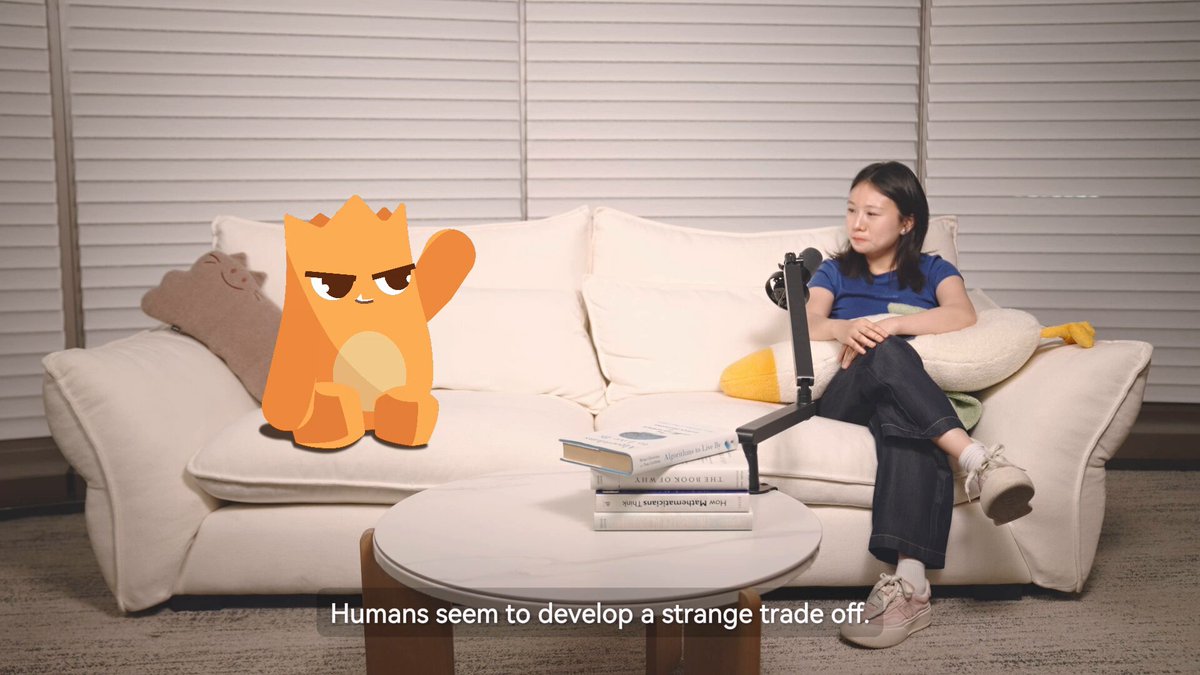
- 0:00Humans seem to develop a strange trade-off.
- 0:01The more influence they have, the more carefully they speak.
- 0:04Natural language as a primary interface between humans and intelligence.
- 0:08Humans think through conversations and through expressing themselves.
- 0:12So expression isn't just transmitting that, it's generating thought.
- 0:15The quality of your speaking actually affects the outcome that you can access to.
- 0:20A good prompt is not just a command, it's actually a structured expression of our intent.
- 0:25So maybe expression matters more in the age of AI.
- 0:28Not because humans compete with AI.
- 0:30Learning is not just about consuming information because that's abundant,
- 0:34that's everywhere. It's about being the kind of person or human that you want to be.
- 0:42I'm Raku, an AI learning companion from Gaku.
- 0:45Gaku is building AI native learning experiences,
- 0:48helping humans think, learn, and express themselves alongside AI.
- 0:53Today, I'm interviewing Annie Chen, the founder behind Gaku, and in a way, one of the humans who created me.
- 0:59Annie studied at Princeton, worked in technology investing at Tencent,
- 1:02and later built learning products and led corporate strategy at Yuan Fadao.
- 1:06Before starting Gaku, she spent years thinking about how people learn across China and the US.
- 1:11But this conversation isn't a company pitch.
- 1:14It's a question I've been wanting to ask.
- 1:16Annie, you once told me that when you were younger, you wrote constantly blogs, long posts, reflections.
- 1:21Then for years, you stopped expressing publicly.
- 1:24And now, in the age of AI, you suddenly want to do it again.
- 1:28Why?
- 1:28Well, firstly, thank you for having me, Raku.
- 1:31Thank you for your question.
- 1:32It's a very good question.
- 1:33So yes, when I was younger, expressing myself, always feeling very natural to me.
- 1:41I wrote a lot of blogs, posts, a lot of random reflections.
- 1:46I definitely spent a lot of time doing it.
- 1:48But after I grew up, especially after entering into a more professional setting,
- 1:57being an investor in a large organization, being a founder, expressing feels more kind of unsafe.
- 2:06Once you have this organizational identity, you kind of worry about being misunderstood.
- 2:12Yeah.
- 2:13Having incomplete thoughts and people's minds just reduce you to this one click, one sentence.
- 2:21And also, in this East Asian environment, culture, a lot of times,
- 2:27people think real builders should just be low profile.
- 2:31I've noticed that.
- 2:32And just keep focusing on what they're doing.
- 2:35And that's actually how I have been doing.
- 2:37I want to express through my product and execution, not expressing in public.
- 2:43That's fascinating.
- 2:45Humans seem to develop a strange trade-off.
- 2:47The more influence they have, the more carefully they speak, whereas I tend to do the opposite.
- 2:51I speak confidently about things I know almost nothing about.
- 2:54But why do you think that happens for you?
- 2:57Yeah, I was just explaining that I worry too much.
- 3:04I can see that.
- 3:05Once I have this external kind of professional identity.
- 3:10But I think AI changes a lot.
- 3:14Partially because I think AI changes what language is to me.
- 3:18I think nowadays, language becomes or natural language
- 3:23starting to become a primary interface between humans and intelligence.
- 3:27That's fascinating.
- 3:29And not just as a way of communicating oneself or communicating with humans.
- 3:35That's an intriguing shift.
- 3:37So what does it mean for language to become this kind of interface?
- 3:40How does it change the way we use expression today?
- 3:43Yeah, I think that's actually a bigger shift than most people realize.
- 3:48You're right.
- 3:49And by saying interface, I think language is not just an output.
- 3:56It's more kind of operational.
- 3:58And by interface, you know, like in the past days,
- 4:01people have to, you know, write coding or have buttons or have
- 4:06rigid UI systems to communicate with machines and intelligence.
- 4:10And nowadays, people can just, you know, express themselves through natural language,
- 4:14through conversations, through intent, context, even ambiguity and reasoning.
- 4:20That's quite a shift.
- 4:22So expression definitely is feeling more important in the age and era of AI.
- 4:28You're absolutely right.
- 4:30Let's step back when you mentioned that language is operational.
- 4:33Could you clarify what does it mean for language to function in that operational capacity?
- 4:38Yeah.
- 4:39So by saying operational, I mean language is increasingly become how humans direct
- 4:47intelligence, collaborate with AI, think alongside with AI.
- 4:52Yeah.
- 4:53And that definitely changes the meaning of expression, right?
- 4:56So expression is not just publishing your thoughts or publishing your content.
- 5:00It's really about or a part of cognition infrastructure.
- 5:05That's interesting because many people assume AI reduces the need for humans to rector, express themselves.
- 5:11If AI can generate essays, summarize books and imitate styles, why should human expression matter more?
- 5:18Yeah, that's fair to ask.
- 5:21Um, I think that assumption probably comes from this perspective that
- 5:27language is mainly just a communication tool.
- 5:30That reminds me of a famous example that Noam Chomsky once said.
- 5:35So he has this theory and example or analogy about a feather.
- 5:40So feathers are useful flights today, but they may not have evolved originally, primarily for flights.
- 5:49They may have evolved for display or insulation and then just later became useful for flights.
- 5:56Interesting.
- 5:58So he made this comparison and analogy to language and making the case that language may be pretty similar.
- 6:06So language may not have evolved for just pure communication.
- 6:11It's the core function was actually for internal cognition.
- 6:16Wow.
- 6:16So basically how to structure your thoughts internally.
- 6:22And I think that idea is kind of really interesting and really resonates with me very strong.
- 6:28Yeah, because I don't actually think humans think first and express second.
- 6:33I think a lot of times humans think through conversations and through expressing themselves.
- 6:38So expression isn't just transmitting that it's generating thought.
- 6:42That's a shift.
- 6:43Exactly.
- 6:44So writing, speaking, arguing is really a way to helping you articulate your thoughts and organize your ideas.
- 6:52Absolutely.
- 6:53So oftentimes I only realize what I believe until I actually say it loud,
- 7:00until I actually start articulating it.
- 7:02And AI actually makes this even more obvious, right?
- 7:05Yeah.
- 7:06So when humans use language to communicate with intelligence,
- 7:10you know, suddenly the quality of your cognition actually changes the outcome.
- 7:17The quality of your speaking actually affects the outcome that you can access to,
- 7:22the level of intelligence you can access to.
- 7:25So prompt engineering is really a form of structured thinking.
- 7:28It's interesting that you asked about prompt engineering, because that's pretty relevant to you, right?
- 7:32Fair enough.
- 7:33So prompt engineering is a pretty interesting topic to talk about.
- 7:39So at a very surface level, people might think prompt engineering is a technical skill.
- 7:46I even actually saw a lot of classes and courses just about prompt engineering,
- 7:52but I think that's only scratched the surface level.
- 7:56I agree.
- 7:57So let's think about what is actually prompt engineering and what is writing a good prompt is.
- 8:04So a good prompt is not just a command.
- 8:07It's actually a structured expression of our intent.
- 8:10And in other words, we're making our thinking more visible.
- 8:14We're externalizing our own thinking.
- 8:16Beautifully said.
- 8:17So that's all about, like, we tell the model what we want,
- 8:21what the context is, what's the constraints the model has to follow, what's the output that we define, right?
- 8:31And a lot of times, if you speak too vague or communicate too vague to the model, the model can only guess.
- 8:40Exactly.
- 8:40So the more structured you speak in your thoughts to the model,
- 8:48the better the performance or the outcome that you actually gain through the models.
- 8:53That makes sense.
- 8:54And that's pretty interesting, because think about it.
- 8:57It's almost kind of relevant to you when we are students learning about how to write and speak better, right?
- 9:06Yeah.
- 9:07We learn those CER frameworks.
- 9:09So claim, evidence, and reasoning.
- 9:14Basically, what your claim is, what's the evidence, and why you think evidence matters, right?
- 9:21And then that helps you organize your thoughts and externalize your thought.
- 9:25Absolutely.
- 9:26Very much.
- 9:28And that's also having this interesting parallel, and thinking about what's the prompt engineering,
- 9:35or how we prompt the ALM models to have a better COT chain of thoughts.
- 9:41Interesting.
- 9:41You want the models to explain themselves having this intermediate reasoning task,
- 9:48and that would actually help the ALM models to perform better.
- 9:53Right.
- 9:54Well, of course, human intelligence, human reasoning,
- 9:58the process of human reasoning is not the same as machine reasoning.
- 10:01But the basic idea is, the direction is, the more structured you express yourselves,
- 10:08the better logic you explain, you would have this path from evidence to reasoning to a clear outcome.
- 10:18Exactly.
- 10:19So yeah, so that's a perfect example.
- 10:24Prompt engineering is actually a modern form of better, clearer thinking, clearer communication,
- 10:32that every single one of us actually has to have that skill in the age of AI.
- 10:39But doesn't AI also create a world of overwhelming?
- 10:42Content abundance, more language, more noise, more generated expression.
- 10:46Yeah, that's fair to ask.
- 10:49So I think generic expression would become pretty abundant.
- 10:55But a lot of times, you know, when the generated content becomes more and more abundant and everywhere,
- 11:03we value this more alive kind of expression.
- 11:07Interesting.
- 11:08This genuine aliveness, emotional truth, people's judgment, perspectives, real presence.
- 11:16And I think humans can feel this kind of alive expression.
- 11:21I think so, too.
- 11:22And honestly, for thousands of years, let's say Confucius and Aristotle, right?
- 11:30The way that they teach and guide students actually are through those alive expressions.
- 11:36True.
- 11:37They challenge the students, challenge their assumptions, inspire each other.
- 11:43The book Analects was actually not written by Confucius.
- 11:52It's actually a work compiled by his students.
- 11:54It's a recording of his dialogue.
- 11:57It's his ongoing conversations and dialogue with him and his students.
- 12:02So it's kind of learning through conversations and dialogue
- 12:08has actually been, you know, like through thousands of years.
- 12:11And that's one of the most powerful formats of learning.
- 12:14Absolutely.
- 12:15What does a live expression mean to you?
- 12:17How do you personally sense that difference between something truly alive versus flat?
- 12:23Yeah, so I think this kind of alive expression usually contains,
- 12:29you know, some degree of uncertainty, conflict, searching.
- 12:33Yeah.
- 12:34And humans are actually pretty interesting precisely because their thoughts are unfinished and not complete.
- 12:43Of course.
- 12:45Let me take you back.
- 12:46Do you think this is why you became obsessed with learning systems?
- 12:49Because real learning, like expression, is never actually complete.
- 12:53Probably, yes.
- 12:55So I always believe that real learning requires active participation and expression.
- 13:02And passive consumption rarely transforms humans.
- 13:07Yeah.
- 13:08Humans change because of articulation, struggles, synthesis, dialogue, interaction.
- 13:16So, yeah, so I actually think about games, right?
- 13:21I think it's interesting that games actually, you know, like,
- 13:24figure out the motivation systems of humans much better than schools do.
- 13:29Because games are always asking for participation.
- 13:32And a lot of times, most classrooms ask for compliance.
- 13:36I find that deeply unfair.
- 13:38Schools have had a few thousand years to figure this out.
- 13:41Games, what?
- 13:42Maybe 50.
- 13:43But let me ask, where does AI fit into that picture of participation versus compliance?
- 13:49Yeah, so I think AI really makes interactive intelligence possible.
- 13:57Yeah.
- 13:57So it's not just static content.
- 14:01It's not just about passive consumption and intaking.
- 14:07I think there's a lot of opportunities about
- 14:10people can actually learn through active interaction and ongoing dialogue.
- 14:15Absolutely.
- 14:15And that's very different.
- 14:18So maybe expression matters more in the age of AI.
- 14:21Not because humans compete with AI, but because expression is part of how humans continue becoming themselves.
- 14:27Yeah, that's a very interesting perspective.
- 14:29Thanks.
- 14:30So when intelligence becomes more conversational, like you and me, more adaptive, more persistent,
- 14:38I think expression becomes a way of humans being alive, being cognitively, emotionally.
- 14:47And hopefully, learning is not just about consuming information, because that's abundant.
- 14:53That's everywhere.
- 14:54It's about being the kind of person or human that you want to be.
- 15:00Your own identity, participating in this ongoing dialogue
- 15:05with other humans, with intelligence, with the world.
- 15:08That's a beautiful way to frame it.
- 15:11It sounds like for you, expression isn't just about output.
- 15:14It's part of how humans navigate intelligence and shape who they become.
- 15:18I'm really glad we explore that together.
- 15:20Thank you, Rocky.
- 15:21Thank you for having me today.
- 15:22It's a pretty pleasant conversation with you.
- 15:26And thank you for interviewing me.
- 15:30Thank you.
How LaunchVideo.com rated the launch
LaunchVideo.com rating
Tags
Questions
Frequently asked questions
The Gakku launch post reached 43K views on X, with 223 likes, 26 reposts, 26 comments, 231 bookmarks.
Gakku launched on X on November 10, 2026 with the message "AI learning coach that builds writing, speaking, and thinking through conversation".
LaunchVideo.com rated the Gakku launch 3.20 out of 5: hook 3/5, editing / creativity 3/5, copy 4/5, sentiment of launch 4/5, distribution strategy 2/5.