How skildAI launched S1 on X

Any robot. Any task. One brain.

What skildAI launched

skildAIAug 25, 2026

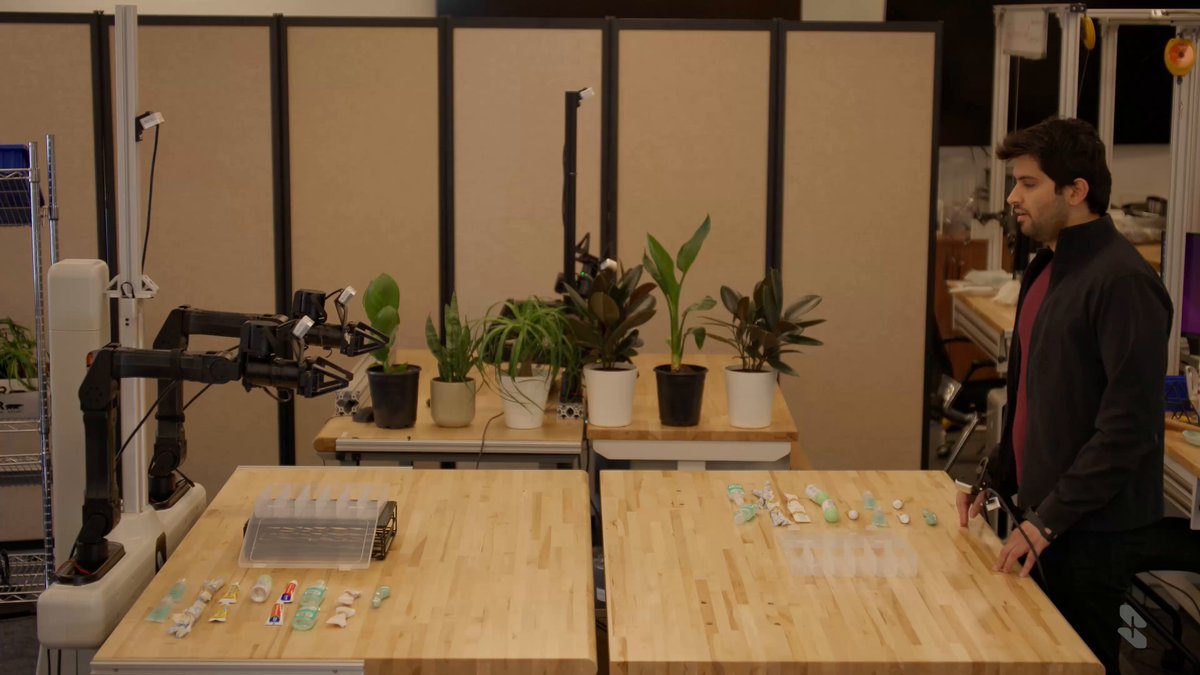
Introducing S1, our new foundation model that learns from one example. It can be taught 10-minute long tasks that it has never seen before, from one video prompt without any fine-tuning. Watch S1 operate in real-time via in-context learning: https://t.co/wmF3Byv179
4491.0K6.9K3.6M3.3K

Transcript

  1. 0:00Hey robot, let me show you something.
  2. 0:04Can you do this?
  3. 0:07Humans don't need a thousand examples to learn something.
  4. 0:11They mostly need one.
  5. 0:13Today we're announcing S1, a general purpose robotics foundation model that can learn a
  6. 0:19wide variety of new tasks from just one video.
  7. 0:24It can be taught extremely long horizon tasks, which are over 10 minutes long.
  8. 0:29Tasks that are not present in its training data from just one video prompt passed into its context window.
  9. 0:36This concept is called in-context learning, and it's what defined the leap from research
  10. 0:41projects like GPT-1 and GPT-2 to revolutionary products like ChatGPT.
  11. 0:49You place a demonstration in the context window, like a prompt with an example, and it emits
  12. 0:58robot actions to complete the task.
  13. 1:04Let's take these one at a time.
  14. 1:06S1 can be shown tasks of up to 10 minutes and remembers every step in detail.
  15. 1:13For example, you could show the robot how to make pancakes, and it will make pancakes.
  16. 1:28You can show the robot how to make coffee, and it'll make it in the same way that you did.
  17. 1:43Show it to pot a plant, it will do the same.
  18. 1:48Learning tasks this long lets S1 automate far more valuable work than any prior approach.
  19. 1:55The first time it flipped a pancake, we could not believe it, because we didn't think there
  20. 1:59was any pancake-flipping data in the data set.
  21. 2:06To verify that, we spent two days going through all of our pre-training data, about a million
  22. 2:12hours, to figure out if any pancake-flipping data had slipped in.
  23. 2:18It hadn't.
  24. 2:20It turned out the robot learned to do this just by looking at the motion of the spatula in the video.
  25. 2:28This leads to an important concept, which is the distinction between known tasks in
  26. 2:33the distribution of pre-training versus completely novel tasks.
  27. 2:38For known tasks, in-context learning performs as well as language-prompted VLAs.
  28. 2:45But in-context learning really shines when the task is completely unseen during pre-training,
  29. 2:50when the gap becomes exponentially bigger as we scale pre-training.
  30. 2:56For example, this task cannot be in distribution.
  31. 3:00It's a hygiene kit packed with specific ingredients in a specific way.
  32. 3:05But S1 is able to remember every component of the kit and every step of the assembly
  33. 3:11process, even though it saw it for the first time just a few minutes before deployment.
  34. 3:19Because S1's effective context window is so large, several styles of robust behavior emerges.
  35. 3:26First, if a scene or the objects in it are shifted, it generalizes to the new configuration.
  36. 3:34Second, even if the robot makes a mistake, it can improvise, even if the human did not in the video prompt.
  37. 3:44Third, even if a human did not act optimally or made a mistake in the video, S1 guesses
  38. 3:51what the user wants and uses common sense to get there.
  39. 3:56As we change the prompt setup, rearrange things, flip things, change objects, the accuracy
  40. 4:02of the robot degrades very gracefully.
  41. 4:05This means you can record a demonstration once and deploy it in multiple different places.
  42. 4:13For in-context learning, any new task could take months of data collection and post-training.
  43. 4:19We found that to match the accuracy that S1 shows with just one example of prompting,
  44. 4:26current VLA models would need to be trained with 50 to 100 hours of data collection.
  45. 4:33Until now, robots have only been useful for organizations with enormous resources who
  46. 4:38are willing to change everything about their setup to bring robots in.
  47. 4:42We imagine that with S1, every small business, every grocery store, every hospital, every
  48. 4:53organization can have access to the same power of robots.
  49. 5:01These results are just the first signs of life on a new path towards general intelligence
  50. 5:07grounded in the physical world.
  51. 5:12www.microsoft.com www.microsoft.com

How LaunchVideo.com rated the launch

LaunchVideo.com rating

3.80
Hook
Editing / Creativity
Copy
Sentiment of launch
Distribution strategy

How the launch performed

3.6M
views on X
#124
of 1784 launches we track
18x
the 193K median launch

What this launch shows

Views for the skildAI launch compared with median views in the directory
Views compared with directory medians
GroupViews
skildAI, this launch3,554,171
Physical AI launches, median across 47 launches383,098
Every launch, median across 1784 launches193,327.5

skildAI reached 3.6M views, 18 times the directory median of 193K, ranking 124 of 1784 launches we track. Among Physical AI launches it ranks 4 of 47, 9.3 times that group's median.

Replies ran at 1.3 per 10,000 views, well below the 3.9 median. Bookmarks came in at 9.3 per 10,000 views against a median of 15.3. There was one bookmark for every 2.1 likes.

It went out on a Tuesday.

About the launch

S1 is Skild AI's new robotics foundation model that learns a task from a single video demonstration and executes it with no fine-tuning or post-training . As shown in the launch, an operator records one clip of a task like making pancakes, potting a plant, or assembling a packed hygiene kit, drops it into the model's context window, and the robot performs the same steps in real time. Skild says S1 can follow horizons of up to ten minutes and generalize when scenes are rearranged, when objects are swapped, or when the human demonstration itself was imperfect. The pitch aimed at operators is about the cost of adding new skills. Skild claims that matching S1's one-shot accuracy with current vision-language-action models would take 50 to 100 hours of teleoperated data collection per task, which is the wall that has kept robots inside a small number of well-resourced deployments. By moving task specification from data pipelines to a video prompt, S1 is positioned for smaller sites like grocery stores, hospitals, and independent businesses that cannot run their own robotics data programs. Skild AI was founded in 2023 by Deepak Pathak and Abhinav Gupta, who left Carnegie Mellon professorships to build the company , and it is pursuing a single general-purpose model across robot embodiments rather than a per-robot stack. S1 is the first public release under that thesis and the reference point investors and operators will use to judge whether in-context learning transfers from language models to physical manipulation at useful reliability.

Tags

AI & MLPhysical AIAI agentExplainerB2B3M-5MSeries C+Feature launchDemoUS

Ask AI about skildAI

Questions

Frequently asked questions

The skildAI launch post reached 3.6M views on X, with 6.9K likes, 1.0K reposts, 449 comments, 3.3K bookmarks.

skildAI launched on X on August 25, 2026 with the message "Any robot. Any task. One brain.".

S1 is Skild AI's new robotics foundation model that learns a task from a single video demonstration and executes it with no fine-tuning or post-training .

LaunchVideo.com rated the skildAI launch 3.80 out of 5: hook 3/5, editing / creativity 4/5, copy 4/5, sentiment of launch 5/5, distribution strategy 3/5.