How Resend launched on X
Email for developers
What Resend launched

We built our own email infrastructure from scratch. Announcing Resend Forge: ▪️ 129x faster at p99 ▪️ 99%+ delivery rate across inboxes ▪️ activate for your account today It's fast, reliable, and provides best-in-class deliverability. 👇 https://t.co/sNhgOKuVVW
Transcript
How LaunchVideo.com rated the launch
LaunchVideo.com rating
About the launch
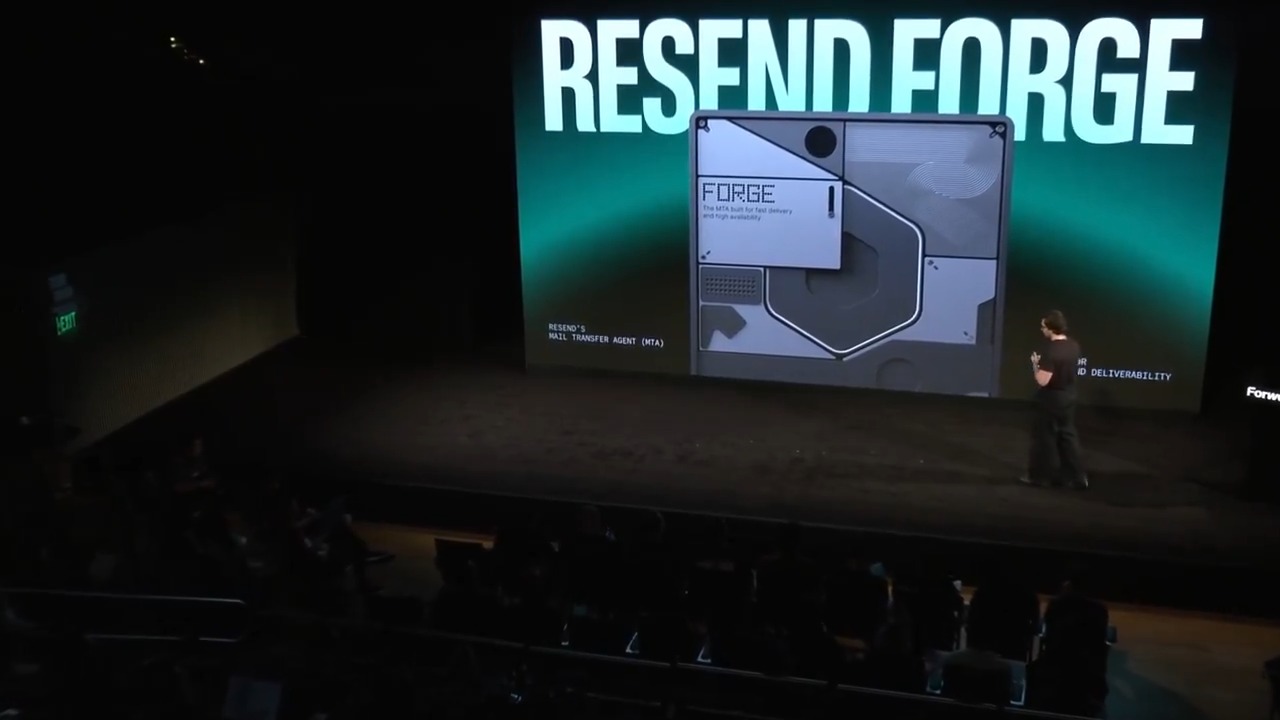
What did Resend launch? On October 23, 2026, Resend announced Resend Forge, its own email sending infrastructure built from scratch. The company revealed Forge at Resend Forward, its first conference, alongside a second product called Inboxes, shared inboxes for agents and humans. The launch post on X summed Forge up in three lines: 129 times faster at p99, a delivery rate above 99 percent across inboxes, and available to activate for your account today. Forge is a mail transfer agent, the part of email infrastructure that actually hands a message to the receiving server. It powers the transactional email Resend customers already send through its API, such as password resets, receipts, magic links, and product notifications. Why did Resend build its own email infrastructure? Resend started at the surface. Its open source React Email project lets developers build email templates in components, the same way they build the rest of an app. The company then focused on sending and receiving, with a modern API and dashboard. Until this launch, though, that mail left on rented infrastructure, through a third-party provider. With Forge, Resend is moving down the stack. Forge sends from IP blocks Resend owns and operates, so the company controls the whole path from the API call to the addresses an email leaves from. Resend says that gives it direct control over connection pooling, retries, backoff, and queue durability, plus more real-time visibility into every message. How fast and reliable is Resend Forge? Resend says Forge is 129 times faster at the 99th percentile than its previous engine, and reports a delivery rate above 99 percent across the major inbox providers. Before the public rollout, hundreds of customers had already sent more than 10 million emails through Forge, with Profound, Firecrawl, and Clay among the named users. Resend publishes rolling seven-day numbers on its Forge page. In the snapshot reviewed for this page, median time to delivery across all providers was 0.8 seconds on Forge versus 1.4 seconds on the legacy engine, with Google at 0.7 seconds and Apple on par at 4.8 seconds. Because those figures update every week, they will move over time. How does Resend keep Forge deliverability high? Resend bought its IP blocks on the transfer market after checking each block's history, then warmed them up gradually over weeks or months for each provider. Forge is a shared pool, so a customer's mail leaves from the same addresses as other Resend senders. That lets a brand new domain send well on day one, and it is why Resend runs an abuse detection system that watches accounts and stops phishing and fraud senders, sometimes before their first bad email. The team also keeps a separate configuration for each major receiver, such as Gmail, Outlook, Yahoo, and Apple, and relies on relationships with postmasters to fix problems quickly. If Forge has an incident or cannot complete a delivery, mail automatically falls back to the legacy engine, so messages are not lost. How do customers activate Resend Forge? Forge is available to any Resend customer. You open a domain in your Resend account, click Activate Resend Forge, and add a single CNAME record to your DNS. Code, SMTP credentials, and webhooks stay the same, and eligible domains are moved over after DNS verification and sender reputation checks. Open and click tracking are not supported on Forge yet, so domains with tracking enabled are routed to the legacy engine for now. PlanetScale CEO Sam Lambert described the result as faster time to inbox, fewer retries, and better observability. Profound cofounder and CTO Dylan Babbs called activation a no-brainer, with no code changes. Who founded Resend? Zeno Rocha, Bu Kinoshita, and Jonni Lundy founded Resend in 2023, building on the React Email project, and joined Y Combinator's Winter 2023 batch. How did the Resend Forge launch perform on X? Resend posted the launch video from its company account on October 23, 2026. The post reached about 79K views, with 651 likes, 25 reposts, 29 comments, and 208 bookmarks, as recorded on this LaunchVideo.com directory entry. The account had about 35K followers at the time, so the post reached a little over twice its audience. The video runs nearly seven minutes and opens as a conference talk, with a founder telling the story of joining Y Combinator in 2023 and needing to pivot. LaunchVideo.com rated the launch 3.0 out of 5, with 4 out of 5 for copy, 3 for editing, sentiment, and distribution, and 2 for hook. What can founders learn from the Resend Forge launch video? The Resend Forge launch post shows how strong copy can carry a technical launch. Three short lines with hard numbers, 129 times faster, over 99 percent delivery, and activate today, told developers everything they needed. The high bookmark count suggests many saved it to come back to. The video is where a founder-led launch video could have worked harder. A seven-minute keynote that opens with a YC story takes a long time to reach Forge. A short cut that leads with the speed comparison, then the founder's why, would likely hold more viewers, with the full talk linked for those who want it. For developer tools, the lesson is to lead with the proof, keep the clip tight, and save the backstory for later. That is the kind of launch planning LaunchVideo.com helps teams with.
Tags
Questions
Frequently asked questions
The Resend launch post reached 79K views on X, with 651 likes, 25 reposts, 29 comments, 208 bookmarks.
Resend launched on X on October 23, 2026 with the message "Email for developers".
What did Resend launch?
LaunchVideo.com rated the Resend launch 3.00 out of 5: hook 2/5, editing / creativity 3/5, copy 4/5, sentiment of launch 3/5, distribution strategy 3/5.