How LlamaIndex launched OCRia-nano-1 on X
Reads text, tables and layout from documents on your own CPU
What LlamaIndex launched

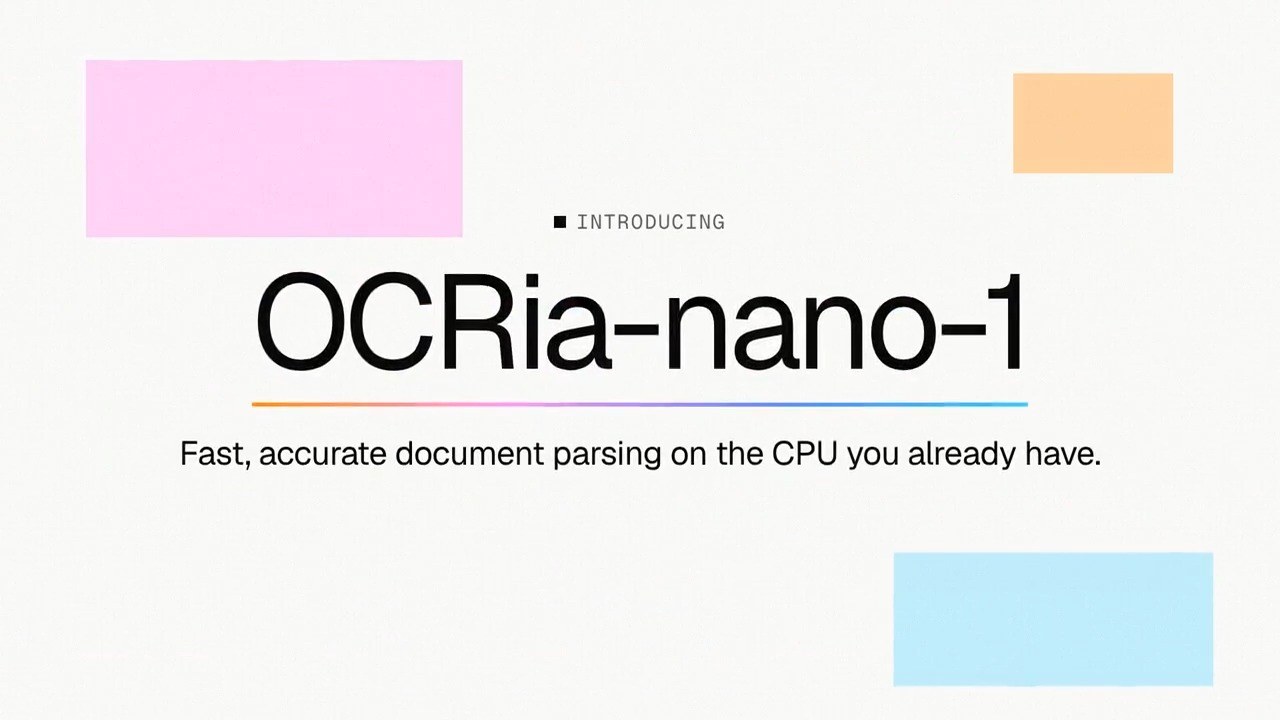
Today we're releasing OCRia-nano-1, the smallest model in the OCRia family. 8.1M parameters, open weights on Hugging Face 🦙 It reads text, reconstructs tables and recovers page layout, all on your own CPU. → 426 ms per page on a single CPU core → 27.8 pages per second with https://t.co/WdChXxznUw
How LaunchVideo.com rated the launch
LaunchVideo.com rating
How the launch performed
- 13K
- views on X
- #1528
- of 1716 launches we track
- 0.1x
- the 199K median launch
What this launch shows
| Group | Views |
|---|---|
| LlamaIndex, this launch | 12,910 |
| Similar-sized accounts, median across 108 launches | 410,759.5 |
| AI infrastructure / MLOps / evals launches, median across 185 launches | 211,030 |
| Every launch, median across 1716 launches | 198,983 |
LlamaIndex reached 13K views, 0.1 times the directory median of 199K, ranking 1528 of 1716 launches we track. Among AI infrastructure / MLOps / evals launches it ranks 168 of 185, 0.1 times that group's median. The post came from an account with 124K followers and reached 0.1 times that many people, ranking 105 of 108 launches from accounts of a similar size.
Replies ran at 13.9 per 10,000 views, well above the 3.8 median. Conversation in the first hours is what the ranking model rewards with more reach. Bookmarks came in at 206.8 per 10,000 views against a median of 15.1. One bookmark for every 1.1 likes is a high ratio and usually means people intend to come back and try the product.
The launch video runs 27 seconds, against a directory median of 73 seconds. It went out on a Monday.
Same company
More from LlamaIndex

More launches in its category
 Rayline: ARC by RaylineRoutes each request to the right AI model and thinking depth6.8M views
 ChatAndBuild: Living BrainOne persistent memory shared across ChatGPT, Claude, Cursor and custom agents6.3M views
 State MachinesTest your agent against enterprise APIs that work like the real ones.5.8M views
 EagleAI at blazing speed5.2M views
 You.comSearch and inference for AI4.4M views
About the launch
OCRia-nano-1 is the smallest model in LlamaIndex's OCRia family, an 8.1 million parameter parser that reads page text, rebuilds tables, and recovers layout on a local CPU. It is built for high-volume ingestion and for agents that need a fast pass over everyday files, including digitally generated reports, straightforward contracts, invoices with simple tables, and routine scans. LlamaIndex, co-founded by Jerry Liu and Simon Suo, released the weights on November 23, 2026, about a month after OCRia-1, its 4 billion parameter vision-language model, began powering LlamaParse. Nano is distilled from that model at roughly one five-hundredth of the parameter count, so ordinary pages can be parsed locally as a first pass. Complex tables, handwriting, degraded scans, mathematical notation, and charts stay with OCRia-1. Nano has no chart model and keeps charts as images. Seven ONNX models make up the 8.1 million parameters, and they run inside LiteParse, the company's local parser, rather than as a standalone script. A line detector and script router send each line to a recognizer for Latin text, Chinese, Japanese, and Korean, Arabic and Hebrew, or about 17 other scripts, and can flag upside-down text. LayoutNet, 4.27 million parameters, recovers table rows, columns, and spanning headers and labels blocks such as headings, lists, captions, and page headers and footers. LlamaIndex reports 426 milliseconds per page on one CPU core, with 90 percent of measured pages under 862 milliseconds, and 27.8 pages per second on 16 workers, about twice the throughput of LiteParse with Tesseract. On the company's ParseBench-2, Nano scores 59.2 overall and 59.5 on tables, ahead of Marker at 52.5 and Indra at 55.1. Indra is faster in that same test, at 29.6 pages per second. Parsed output is Markdown, plain text, or JSON with bounding boxes, from the command line, Python, Node.js, or WebAssembly in the browser, where the model card reports about 1 to 4 seconds per scanned page on one thread. LiteParse is Apache 2.0. After lit models pull ocria-nano, Nano is the default OCR backend and Tesseract remains selectable. The weights use the OCRia-nano-1 license, based on Open RAIL-M. Research, teaching, evaluation, and personal use are free, as is commercial use by organizations under $2 million in annual revenue and under $2 million in total funding. A commercial license is required above those thresholds, and for any document parsing, OCR, or extraction product or service that competes with LlamaParse or LlamaCloud, at any size.
Tags
Questions
Frequently asked questions
The LlamaIndex launch post reached 13K views on X, with 292 likes, 33 reposts, 18 comments, 267 bookmarks.
LlamaIndex launched on X on November 23, 2026 with the message "Reads text, tables and layout from documents on your own CPU".
OCRia-nano-1 is the smallest model in LlamaIndex's OCRia family, an 8.1 million parameter parser that reads page text, rebuilds tables, and recovers layout on a local CPU.
LaunchVideo.com rated the LlamaIndex launch 2.60 out of 5: hook 2/5, editing / creativity 2/5, copy 5/5, sentiment of launch 3/5, distribution strategy 1/5.